Secure Your Dream Home with a Conventional Loan in Greenwood Village, CO

Welcome to your premier local resource for home financing in Colorado. Whether you are purchasing your first home, upgrading to a larger space in Arapahoe County, or investing in real estate, securing the right mortgage is the most critical step in your journey. At Primary Residential Mortgage, Inc. (PRMI), Randy J. Spierings provides expert guidance, competitive rates, and tailored lending solutions to help you achieve your homeownership goals. Among our most popular and versatile financing options is the Conventional Loan.

Primary Residential Mortgage, Inc. logo

What is a Conventional Loan?

A conventional loan is a type of mortgage that is not backed, insured, or guaranteed by any government agency, such as the Federal Housing Administration (FHA), the Department of Veterans Affairs (VA), or the United States Department of Agriculture (USDA). Instead, conventional mortgages are offered by private lenders—like banks, credit unions, and mortgage companies like PRMI—and are typically bought by two government-sponsored enterprises (GSEs): Fannie Mae and Freddie Mac.

Because the government does not insure these loans against default, lenders take on more risk. As a result, conventional loans generally require stricter credit and income qualifying standards compared to government-backed loans. However, for borrowers who meet these standards, conventional loans reward them with highly competitive interest rates, flexible terms, and lower overall borrowing costs.

Conforming vs. Non-Conforming Conventional Loans

Conventional loans are generally divided into two main categories: conforming and non-conforming.

  • Conforming Loans: These loans adhere to the strict lending guidelines and maximum loan limits set by the Federal Housing Finance Agency (FHFA), Fannie Mae, and Freddie Mac. In most parts of the country, there is a baseline conforming loan limit, but high-cost areas (like certain counties in Colorado) may have higher limits to accommodate local housing prices.
  • Non-Conforming Loans (Jumbo Loans): If a conventional loan exceeds the FHFA conforming loan limits, it is considered a non-conforming or “Jumbo” loan. Because they cannot be sold to Fannie Mae or Freddie Mac, Jumbo loans remain on the lender’s books or are sold to private investors. Jumbo loans are highly relevant in luxury markets like Greenwood Village, where property values frequently exceed standard conforming limits.

Why Choose a Conventional Mortgage in Greenwood Village?

Greenwood Village, Colorado, boasts a dynamic and highly sought-after real estate market. From stunning single-family homes near the Denver Tech Center (DTC) to luxury estates, buyers need a mortgage that offers power and flexibility. Here are the top benefits of choosing a conventional loan with Randy J. Spierings:

  • Lower Interest Rates for Good Credit: Conventional loans heavily reward borrowers with good to excellent credit scores (typically 700 and above) with some of the lowest interest rates available in the market.
  • Flexible Down Payment Options: While the traditional benchmark is a 20% down payment, conventional loans actually allow down payments as low as 3% for qualifying first-time homebuyers, and 5% for repeat buyers.
  • Cancelable Mortgage Insurance: Unlike FHA loans, which require mortgage insurance for the life of the loan (if you put down less than 10%), Private Mortgage Insurance (PMI) on a conventional loan can be canceled once you reach 20% equity in your home, significantly lowering your monthly payment in the future.
  • Diverse Property Types: Government loans usually require the property to be your primary residence. Conventional loans, however, can be used to finance primary residences, second homes, vacation homes, and investment properties.
  • No Upfront Mortgage Insurance Fee: Government-backed loans often charge a hefty upfront funding fee or mortgage insurance premium at closing. Conventional loans do not have this upfront requirement.
  • Strong Seller Appeal: In a competitive Colorado housing market, sellers and listing agents often prefer offers backed by conventional financing. It signals to the seller that the buyer is financially strong and that the property won’t be subject to the strict appraisal conditions sometimes required by FHA or VA loans.

Comprehensive Conventional Loan Requirements

To qualify for a conventional loan in Colorado, you must meet specific financial criteria. While PRMI offers flexible underwriting, here are the general guidelines for conventional loan approval:

1. Credit Score Requirements

The minimum credit score required for a conventional loan is typically 620. However, because interest rates on conventional loans are highly dependent on credit scores, borrowers with scores of 740 or higher will receive the most favorable interest rates and the lowest PMI premiums. If your score is below 620, Randy J. Spierings can help you explore FHA loans or provide guidance on improving your credit profile.

2. Down Payment Minimums

There is a common misconception that you need a 20% down payment to buy a home with a conventional loan. This is simply not true. Here are the actual down payment requirements:

  • First-Time Homebuyers: Can qualify for a conventional loan with as little as 3% down (using programs like Fannie Mae HomeReady or Freddie Mac Home Possible).
  • Repeat Homebuyers: Can purchase a primary residence with as little as 5% down.
  • Second Homes: Typically require a minimum of 10% down.
  • Investment Properties: Generally require at least 15% to 20% down, depending on the number of units.

3. Debt-to-Income (DTI) Ratio

Your Debt-to-Income (DTI) ratio is the percentage of your gross monthly income that goes toward paying your monthly debts (including your future mortgage payment, car loans, student loans, and minimum credit card payments). For a conventional loan, a DTI of 36% to 43% is ideal. In some cases, with strong compensating factors (like excellent credit or significant cash reserves), lenders may allow a DTI up to 50%.

4. Stable Employment and Income

Lenders want to ensure you have a reliable source of income to repay the loan. You will typically need to provide a two-year employment history. Documentation usually includes W-2s, recent pay stubs, and tax returns. If you are self-employed, Randy J. Spierings specializes in helping business owners navigate the slightly more complex income verification process required by Fannie Mae and Freddie Mac.

5. Cash Reserves

Depending on your credit profile, the type of property you are buying, and your down payment, you may be required to show that you have “cash reserves” in the bank after closing. A reserve is equal to one month’s mortgage payment (principal, interest, taxes, and insurance). Investment properties and multi-unit homes typically require more reserves than single-family primary residences.

Property Types You Can Finance with a Conventional Loan

One of the greatest advantages of conventional financing is its versatility. While government loans are strictly for primary residences, a conventional mortgage opens the door to building diverse real estate portfolios in Greenwood Village, Denver, and beyond.

  • Primary Residences: Single-family homes, townhomes, and approved condominiums where you intend to live for the majority of the year.
  • Second Homes and Vacation Properties: Want a mountain cabin in the Rockies or a weekend retreat? Conventional loans allow you to finance a second home, typically requiring a 10% down payment. The property must be located a reasonable distance from your primary residence and cannot be managed by a timeshare or property management company.
  • Investment Properties: If you want to purchase a rental property to generate passive income, a conventional loan is your primary tool. You can finance 1-unit to 4-unit residential properties (such as duplexes, triplexes, and quadplexes) under conventional guidelines, provided you meet the higher down payment and reserve requirements.

Understanding Private Mortgage Insurance (PMI)

If you put down less than 20% on a conventional loan, your lender will require you to pay Private Mortgage Insurance (PMI). PMI protects the lender in case you default on the loan; it does not protect you, the borrower. However, PMI is a valuable tool because it allows you to achieve homeownership years sooner than if you had to save a full 20% down payment.

Key facts about Conventional PMI:

  • Cost: PMI typically costs between 0.3% and 1.5% of the original loan amount per year. The exact cost depends heavily on your credit score and your down payment amount.
  • Payment Methods: PMI is usually paid as a monthly premium added to your mortgage payment. However, it can also be paid as a single upfront premium at closing, or built into a slightly higher interest rate (Lender-Paid Mortgage Insurance, or LPMI).
  • Cancellation: The biggest advantage of conventional PMI is that it is not permanent. You can request PMI cancellation when your loan balance drops to 80% of the home’s original appraised value. Furthermore, lenders are legally required to automatically terminate PMI when your balance reaches 78% of the original value. You may also request early cancellation if your home has significantly increased in value due to market appreciation or major renovations (requires a new appraisal).

Fixed-Rate vs. Adjustable-Rate Conventional Mortgages

When you choose a conventional loan with PRMI, you have the option to select how your interest rate behaves over time. Randy J. Spierings will help you analyze your long-term financial goals to choose the right structure.

Fixed-Rate Conventional Loans

A fixed-rate mortgage is the most popular choice for homebuyers in Colorado. With this option, your interest rate and your principal-and-interest payment remain exactly the same for the entire life of the loan.

  • 30-Year Fixed: Offers the lowest monthly payment, making it easier to qualify and leaving more room in your monthly budget.
  • 15-Year Fixed: Comes with a higher monthly payment but a significantly lower interest rate. You will pay off your home in half the time and save tens of thousands of dollars in interest.
  • Best For: Buyers who plan to stay in their home for a long time and want the security of a predictable, unchanging monthly payment.

Adjustable-Rate Mortgages (ARMs)

An ARM begins with a fixed interest rate for an initial introductory period (typically 5, 7, or 10 years). After this period ends, the interest rate will adjust annually based on a broader market index.

  • Common Structures: 5/1 ARM, 7/1 ARM, 10/1 ARM.
  • Best For: Buyers who plan to sell the home or refinance before the introductory fixed-rate period ends. ARMs often start with a lower interest rate than fixed-rate mortgages, providing significant upfront savings.

Conventional vs. FHA Loans: Which is Right for You?

Many homebuyers in Greenwood Village find themselves choosing between a Conventional loan and an FHA loan. While both are excellent paths to homeownership, they serve different financial profiles. Below is a detailed comparison to help you understand the differences.

FeatureConventional LoanFHA Loan
Minimum Credit ScoreTypically 620 (740+ for best rates)580 (for 3.5% down)
Minimum Down Payment3% (First-time buyers) / 5% (Repeat buyers)3.5%
Mortgage Insurance (MI)PMI required if down payment is less than 20%. Cancelable.Upfront MIP required, plus annual MIP. Usually permanent.
Property Types AllowedPrimary, Second Home, Investment PropertyPrimary Residence ONLY
Upfront Funding FeeNone1.75% of the loan amount
Appraisal StandardsStandard condition requirements.Stricter health and safety condition requirements.
Best Suited For…Borrowers with good to excellent credit and moderate down payments.Borrowers with lower credit scores or higher debt-to-income ratios.

Conventional Refinancing in Colorado

Conventional loans are not just for buying homes; they are also powerful tools for refinancing your current mortgage. Whether you currently have an FHA loan, a VA loan, or an existing conventional loan, Randy J. Spierings can help you refinance to achieve your financial goals.

Rate-and-Term Refinance

This is the most common type of refinance. The goal is to replace your current mortgage with a new conventional loan that has a lower interest rate, a shorter loan term (e.g., moving from a 30-year to a 15-year), or both. A rate-and-term refinance is also the standard method used to remove FHA Mortgage Insurance. By refinancing an FHA loan into a conventional loan once you have 20% equity, you can eliminate mortgage insurance entirely.

Cash-Out Refinance

Create a professional section image for this content. Context (from section below): Major home renov

  • Major home renovations and remodeling.
  • Consolidating high-interest credit card debt or auto loans.
  • Funding a child’s college education.
  • Purchasing an investment property or second home.

The Conventional Loan Process with Randy J. Spierings

Securing a mortgage shouldn’t be a stressful ordeal. At PRMI, we utilize state-of-the-art technology combined with personalized, local service to ensure your loan process is smooth, transparent, and closes on time. Here is what you can expect when you work with Randy J. Spierings:

Step 1: The Consultation and Pre-Approval

Step 2: Home Shopping and Making an Offer

With your pre-approval in hand, you can confidently tour homes with your real estate agent. When you find the perfect property, you will submit an offer. Because you are backed by conventional financing, your offer will stand out in competitive bidding situations.

Step 3: Formal Application and Disclosures
Create a professional section image for this content. Context (from section below): Step 4: Processi

Step 4: Processing and Appraisal

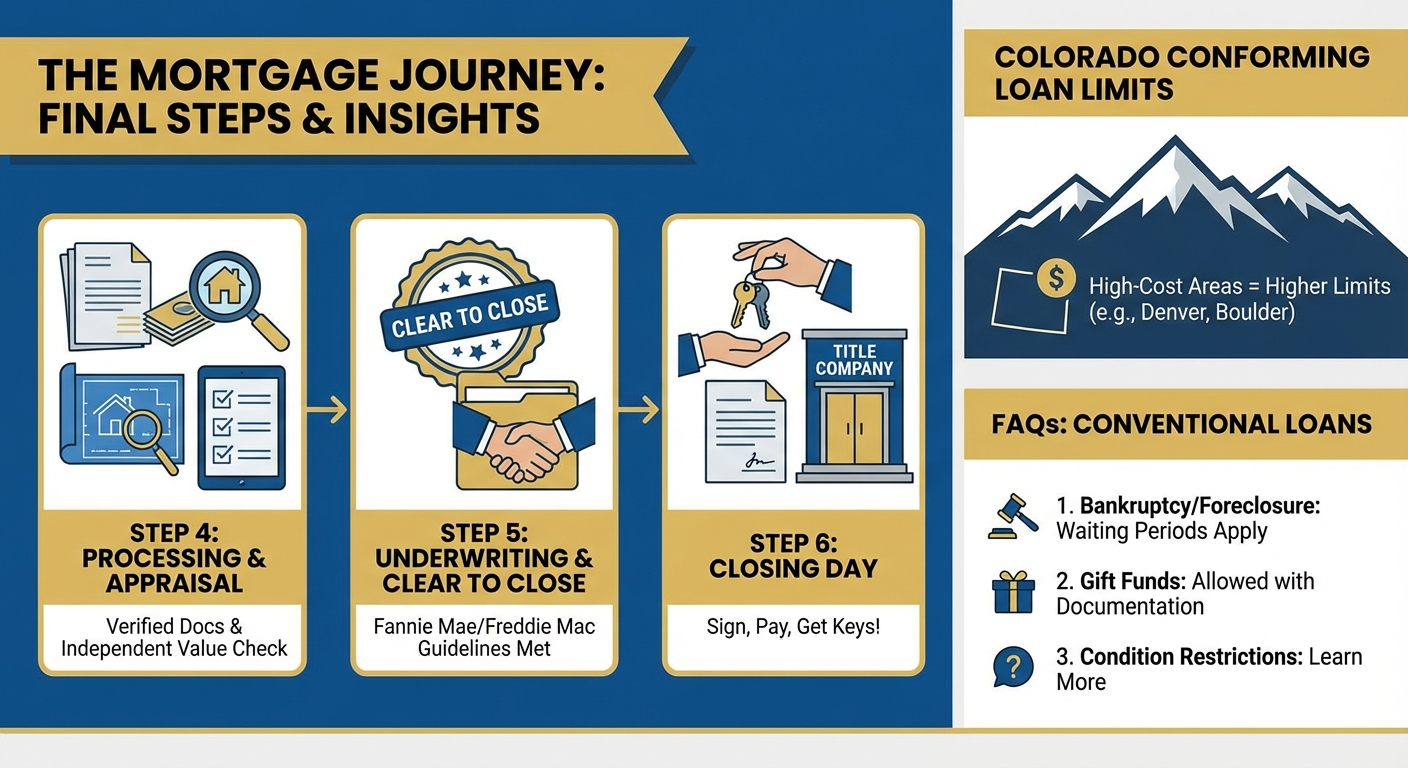
Our local processing team will gather and verify all necessary documentation. Simultaneously, we will order an independent appraisal to confirm the home’s market value. Unlike FHA loans, conventional appraisals focus primarily on value and major structural integrity, without getting bogged down in minor cosmetic repairs.

Step 5: Underwriting and Clear to Close

The underwriter reviews your entire file to ensure it meets Fannie Mae or Freddie Mac guidelines. Once the underwriter is satisfied, they will issue the golden words: “Clear to Close.”

Step 6: Closing Day

You will sit down at the title company (or sign remotely), sign the final paperwork, pay your down payment and closing costs, and receive the keys to your new home!

Colorado Conforming Loan Limits

To qualify for a standard conventional loan, your loan amount must fall within the conforming loan limits set annually by the FHFA. Because home prices fluctuate, these limits are updated every year.

In most standard counties across the United States, the baseline conforming loan limit for a single-family home is set to a specific national standard. However, because areas like Greenwood Village, Denver County, Arapahoe County, and Boulder County have higher-than-average property values, they are often designated as “high-cost areas.” This means you can borrow significantly more under conventional guidelines before having to cross over into Jumbo loan territory.

To find out the exact conforming loan limit for your specific county in Colorado for the current year, please contact Randy J. Spierings directly. We can help you structure your financing to maximize your conventional borrowing power.

Why Work with Randy J. Spierings at Primary Residential Mortgage, Inc.?

Getting a mortgage is one of the largest financial transactions of your life. You need a mortgage professional who understands the nuances of the local market, communicates proactively, and has your best interests at heart.

Randy J. Spierings is a dedicated mortgage professional based right here in Greenwood Village, CO. By choosing Randy and the team at PRMI, you benefit from:

  • Local Expertise: Deep knowledge of the Greenwood Village, Denver Tech Center, and broader Colorado real estate markets.
  • In-House Processing and Underwriting: Because PRMI handles processing, underwriting, and funding in-house, we have complete control over the timeline, ensuring you close on time, every time.
  • Customized Financial Strategies: Randy doesn’t just quote rates; he acts as a mortgage advisor, analyzing your long-term wealth goals to recommend the perfect loan product.
  • Unmatched Communication: You will never be left in the dark. Randy provides continuous updates to you and your real estate agent throughout the entire process.

Ready to get started?


Frequently Asked Questions

1. Can I get a conventional loan if I have a bankruptcy or foreclosure on my record?

Yes, but there are waiting periods. Generally, you must wait 4 years after a Chapter 7 bankruptcy discharge, 2 years after a Chapter 13 discharge, and 7 years after a foreclosure to qualify for a conventional loan. If you need a mortgage sooner, FHA loans have shorter waiting periods.

Absolutely. Conventional guidelines allow you to use monetary gifts from family members to cover some or all of your down payment and closing costs, provided the funds are properly documented with a “gift letter” stating the money does not need to be repaid.

Conventional loans are generally more lenient regarding property condition than government loans. However, the home must still be habitable, safe, and structurally sound. Homes in severe disrepair may not qualify unless you use a specialized conventional renovation loan.

To qualify for the 3% down payment programs (like HomeReady or Home Possible), at least one borrower on the loan must be a first-time homebuyer, which is defined as not having owned a principal residence in the past three years. If you are a repeat buyer, the minimum down payment is 5%.

Yes! The conventional loans originated by PRMI do not have prepayment penalties. You can make extra principal payments each month or pay off the entire mortgage early without facing any fees or fines.

Estimate Your Monthly Payments

Understanding your potential mortgage payments is a crucial step in the home-buying process. Our easy-to-use Mortgage Calculator helps you estimate your monthly payments, so you can plan your finances with confidence. Simply enter your loan details and let our calculator do the rest.

mortgage
Primary Residential Mortgage, Inc. logo

PRMI NMLS 3094. PRMI is an Equal Housing Lender. Credit and collateral are subject to approval. Terms and conditions apply. Programs, rates, terms and conditions are subject to change and are subject to borrower(s) qualification. This is not a commitment to lend. The content in this website has not been approved, reviewed, sponsored or endorsed by any department or government agency.

Equal Housing Lender Logo
Customer satisfaction badge