First-Time Homebuyer Programs in Greenwood Village, CO
Are you dreaming of owning your first home in Greenwood Village, the Denver Metro area, or anywhere in beautiful Colorado? Navigating the real estate market and securing the right mortgage can feel overwhelming, but you do not have to do it alone. With specialized first-time homebuyer programs, down payment assistance, and the expert guidance of Randy J. Spierings, achieving your homeownership goals is more accessible than ever.
Why Buy Your First Home in Greenwood Village, Colorado?
Greenwood Village, located in the heart of Arapahoe County and part of the vibrant Denver Tech Center (DTC) corridor, is one of Colorado’s most desirable places to live. Boasting excellent schools, extensive parks and trail systems, and proximity to major employment hubs, it is a premier destination for young professionals, growing families, and first-time buyers looking to plant roots.
However, the Colorado real estate market is highly competitive. Rent prices continue to rise, making the transition from renting to owning a smart financial move for long-term wealth building. By taking advantage of local and federal first-time homebuyer programs, you can overcome common barriers like high down payments and strict credit requirements.
What is a First-Time Homebuyer Program?
A first-time homebuyer program is a specialized mortgage loan, grant, or financial assistance initiative designed to help individuals purchase their first primary residence. These programs are typically offered by federal agencies, state housing finance authorities, and private lenders.
It is important to note that in the mortgage industry, a “first-time homebuyer” is generally defined as someone who has not owned a principal residence in the past three years. If you owned a home four years ago but have been renting since, you may still qualify for these incredible benefits!
Key Benefits of First-Time Homebuyer Programs
- Lower Down Payments: Many programs allow you to buy a home with as little as 0% to 3.5% down, significantly reducing your out-of-pocket expenses.
- Flexible Credit Requirements: First-time buyer loans often have more lenient credit score minimums compared to traditional jumbo or standard conventional loans.
- Down Payment Assistance (DPA): Access to grants and secondary loans that can cover your down payment and closing costs.
- Reduced Mortgage Insurance: Certain programs offer discounted private mortgage insurance (PMI) rates, lowering your monthly payment.
- Educational Resources: Many state-sponsored programs provide homebuyer education classes to prepare you for the responsibilities of homeownership.
Top First-Time Homebuyer Loans Available in Colorado
As a leading mortgage professional in Greenwood Village, Randy J. Spierings at Primary Residential Mortgage, Inc. (PRMI) offers a wide portfolio of loan products tailored to first-time buyers. Below is an in-depth look at the most popular mortgage options available to you.
1. FHA Loans (Federal Housing Administration)
FHA loans are arguably the most popular choice for first-time homebuyers. Backed by the federal government, these loans are designed to make homeownership accessible to buyers with lower credit scores or limited savings.
- Down Payment: As low as 3.5% of the purchase price.
- Credit Score: Minimum scores generally start around 580 to qualify for the 3.5% down payment advantage.
- Debt-to-Income (DTI): More forgiving DTI limits, allowing you to qualify even if you have student loans or car payments.
- Best For: Buyers who need flexible credit underwriting and have limited funds for a down payment.
2. Conventional 97 Loans (Fannie Mae & Freddie Mac)
Conventional loans are not insured by the government, but specialized programs like Fannie Mae’s HomeReady® and Freddie Mac’s Home Possible® are specifically engineered for low-to-moderate-income first-time buyers.
- Down Payment: As low as 3.0% of the purchase price.
- Credit Score: Typically requires a higher credit score (620 or above) compared to FHA loans.
- Mortgage Insurance: PMI is required if you put down less than 20%, but it can be canceled once you reach 20% equity in the home. (FHA mortgage insurance is often required for the life of the loan).
- Best For: Buyers with good to excellent credit who want to minimize their down payment while retaining the ability to drop mortgage insurance in the future.
3. VA Loans (Department of Veterans Affairs)
If you are an active-duty military member, a veteran, or an eligible surviving spouse, the VA loan is widely considered the best mortgage product available on the market.
- Down Payment: 0% down payment required.
- Mortgage Insurance: No private mortgage insurance (PMI) required, saving you hundreds of dollars each month.
- Interest Rates: Typically offers some of the lowest interest rates available.
- Best For: Eligible military personnel and veterans looking to buy a home in Greenwood Village or surrounding areas.
4. USDA Loans (U.S. Department of Agriculture)
While Greenwood Village itself may not qualify as a rural area, many communities on the outskirts of the Denver Metro area and across Colorado are eligible for USDA financing. This program is designed to encourage rural and suburban development.
- Down Payment: 0% down payment required.
- Location Restrictions: The property must be located in a USDA-designated eligible rural area.
- Income Limits: Your household income must not exceed the specified limits for the area.
- Best For: Buyers looking for properties outside the dense urban centers of Denver who meet the income and location requirements.
Colorado-Specific First-Time Homebuyer Programs (CHFA)
In addition to federal loan programs, Colorado residents have access to the Colorado Housing and Finance Authority (CHFA). CHFA provides financial resources to help Coloradans achieve homeownership through favorable loan terms and down payment assistance.
CHFA FirstStep and CHFA SmartStep
These programs offer 30-year fixed-rate mortgages, often paired with FHA, VA, or USDA loans. They are designed to provide competitive interest rates to low- and moderate-income families.
CHFA Down Payment Assistance Grant
One of the biggest hurdles to buying a home in Colorado is saving for the down payment. CHFA offers a grant that provides up to a certain percentage of your loan amount to be used toward your down payment and closing costs. Because it is a grant, it does not have to be repaid.
CHFA Second Mortgage Loan
If you need more assistance than a grant provides, CHFA also offers a second mortgage option. This acts as a silent second loan that covers your down payment. Payment on this second mortgage is typically deferred until you pay off your first mortgage, sell the home, or refinance.
Note: CHFA programs require borrowers to complete a CHFA-approved homebuyer education class prior to closing. Randy J. Spierings can guide you through the process of qualifying for CHFA benefits.
Loan Program Comparison Guide
To help you understand which program might be right for you, review this quick comparison of the primary loan types available to first-time buyers in Colorado:
| Loan Type | Minimum Down Payment | Minimum Credit Score (Typical) | Mortgage Insurance Required? | Best Feature |
|---|---|---|---|---|
| FHA Loan | 3.5% | 580+ | Yes (Upfront & Annual) | Flexible credit underwriting |
| Conventional 97 | 3.0% | 620+ | Yes (Until 20% equity) | PMI can be canceled later |
| VA Loan | 0% | 580 – 620+ | No (Funding fee applies) | No down payment or PMI |
| USDA Loan | 0% | 640+ | Yes (Guarantee fee) | Zero down for rural areas |
The Step-by-Step Home Buying Process for First-Time Buyers
Buying a house involves several moving parts. As your dedicated mortgage broker in Greenwood Village, Randy J. Spierings will be by your side at every step. Here is what you can expect during the home buying journey:
Step 1: The Initial Consultation
Your journey begins with a conversation. When you contact Randy, you will discuss your financial goals, your current income, your savings, and your timeline. This is a pressure-free environment designed to assess your readiness and map out a customized mortgage strategy.
Step 2: Mortgage Pre-Approval
In the competitive Colorado real estate market, a pre-approval letter is absolutely essential. To get pre-approved, Randy will review your financial documents (W-2s, pay stubs, bank statements, and tax returns) and pull your credit. A pre-approval tells you exactly how much house you can afford and signals to real estate agents and sellers that you are a serious, qualified buyer.
Step 3: House Hunting
Armed with your pre-approval letter, you will partner with a local real estate agent to start touring homes in Greenwood Village, Centennial, Englewood, Denver, or your desired Colorado location. You can shop with confidence, knowing exactly what your budget is.
Step 4: Making an Offer and Negotiation
When you find the perfect home, your real estate agent will help you draft a competitive purchase offer. If the seller accepts your offer, you will sign a purchase agreement and provide an earnest money deposit to secure the contract.
Step 5: Loan Processing and Appraisal
Once you are under contract, Randy and the PRMI processing team will finalize your mortgage application. During this phase, an independent appraiser will visit the property to ensure its market value aligns with the purchase price. You will also schedule a home inspection to check for any hidden issues with the property.
Step 6: Underwriting
Your loan file is sent to an underwriter, who verifies that all financial information is accurate and meets the guidelines of the chosen first-time homebuyer program. They may ask for additional documentation, which is completely normal. Randy will help you provide these documents quickly to keep the process moving.
Step 7: Clear to Close
The magic words! “Clear to Close” means the underwriter has fully approved your loan. You will receive a Closing Disclosure (CD) outlining the final terms of your loan, your exact monthly payment, and the total cash you need to bring to the closing table.
Step 8: Closing Day
You will meet with a title company to sign the final legal documents. Once the funds are transferred and the paperwork is recorded with the county, you will receive the keys to your new home. Congratulations, you are officially a homeowner!
Common Mistakes First-Time Homebuyers Make (And How to Avoid Them)
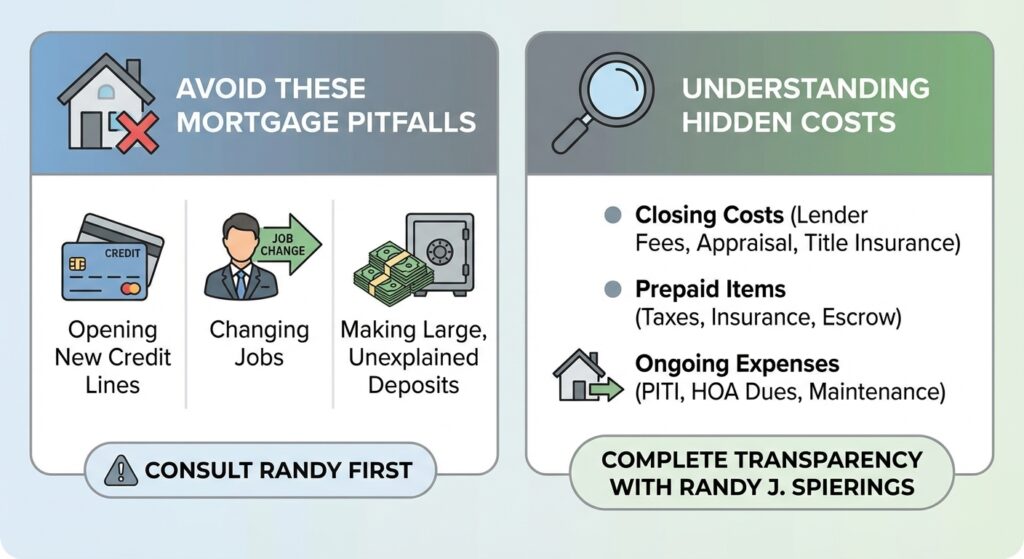
- Opening New Credit Lines: Do not open new credit cards, finance a new car, or take out personal loans while going through the mortgage process. This changes your debt-to-income ratio and can cause your loan to be denied.
- Changing Jobs: Lenders look for steady employment history. If you plan on changing jobs or switching to a commission-based or self-employed role, consult with Randy before making the leap.
- Making Large, Unexplained Deposits: Underwriters need to source where your money comes from. Avoid depositing large amounts of “mattress cash” into your bank account. If you are receiving a financial gift from a family member for your down payment, Randy will help you document it properly with a gift letter.
- Maxing Out Your Budget: Just because you are pre-approved for a certain amount does not mean you have to spend it all. Consider your lifestyle, future goals, and the hidden costs of homeownership (like maintenance and utilities) when deciding on your monthly mortgage budget.
- Skipping the Home Inspection: Never waive a home inspection to make your offer look better unless you are fully prepared to pay for potential major repairs out of pocket.
Understanding the Hidden Costs of Buying a Home
When planning your home purchase, it is vital to look beyond the down payment. First-time buyers must also budget for closing costs and ongoing homeownership expenses. Randy J. Spierings ensures complete transparency so you are never caught off guard.
Closing Costs
- Lender Origination Fees: Costs for processing and underwriting your loan.
- Appraisal Fee: Paid to the independent appraiser to determine the home’s value.
- Title Insurance: Protects you and the lender from any legal claims against the property’s title.
- Recording Fees: Paid to the local county to officially record the transfer of ownership.
- Prepaid Items: You will need to prepay a portion of your property taxes, homeowners insurance, and mortgage interest to establish your escrow account.
Ongoing Homeownership Expenses
Once you move in, your monthly mortgage payment will likely consist of PITI (Principal, Interest, Taxes, and Insurance). Additionally, you should budget for:
- HOA Dues: If you buy a condo, townhome, or a home in a planned community in Greenwood Village, you will likely have monthly or annual Homeowners Association fees.
- Home Maintenance: Experts recommend setting aside 1% to 2% of your home’s value each year for routine maintenance and unexpected repairs.
- Utilities: Transitioning from an apartment to a larger home usually means higher water, gas, and electricity bills.
Glossary of Mortgage Terms for First-Time Buyers

- Amortization: The process of paying off your loan over time through regular, equal payments that cover both principal and interest.
- Debt-to-Income Ratio (DTI): A percentage calculated by dividing your total monthly debt payments by your gross monthly income. Lenders use this to determine how much you can afford.
- Earnest Money: A good faith deposit made when you submit an offer on a house. It is held in an escrow account and applied to your closing costs or down payment on closing day.
- Escrow Account: An account managed by your lender where a portion of your monthly payment is held to pay for your property taxes and homeowners insurance premiums when they are due.
- Fixed-Rate Mortgage: A home loan where the interest rate remains the same for the entire life of the loan, ensuring your principal and interest payment never changes.
- Private Mortgage Insurance (PMI): An insurance policy that protects the lender if you default on the loan. It is typically required on conventional loans if you make a down payment of less than 20%.
Why Choose Randy J. Spierings at Primary Residential Mortgage, Inc.?
Choosing the right mortgage professional is just as important as choosing the right home. Randy J. Spierings is a dedicated mortgage expert based in Greenwood Village, CO, representing Primary Residential Mortgage, Inc. (PRMI)—one of the nation’s premier lending institutions.
Local Expertise, National Strength
By working with Randy, you get the best of both worlds: the personalized, face-to-face service of a local Greenwood Village mortgage expert, backed by the robust lending power, advanced technology, and diverse loan products of a national company like PRMI.
Education-First Approach
Randy believes that an educated buyer is a confident buyer. He takes the time to explain every option, break down the math, and ensure you fully understand the terms of your first-time homebuyer program. There are no silly questions—only opportunities to learn and make empowered financial decisions.
Streamlined, Stress-Free Process
PRMI utilizes state-of-the-art digital mortgage technology. You can securely upload documents, track your loan status, and communicate with Randy’s team seamlessly, making the underwriting process faster and more efficient.
Customized Mortgage Strategies
Randy does not believe in a one-size-fits-all approach. Whether you need a CHFA grant to cover your down payment, an FHA loan to accommodate your credit history, or a Conventional 97 loan to maximize your purchasing power, Randy will tailor a mortgage strategy specifically for your unique financial landscape.
Ready to get started?
Frequently Asked Questions
1. Do I really need a 20% down payment to buy a house in Colorado?
Absolutely not. This is one of the biggest myths in real estate. Through first-time homebuyer programs like FHA, Conventional 97, VA, and USDA, you can purchase a home with anywhere from 0% to 3.5% down. Furthermore, down payment assistance programs can help cover even those small percentages.
2. What credit score do I need to buy my first home?
While a higher credit score will secure you a lower interest rate, you do not need perfect credit to buy a home. FHA loans often accept scores as low as 580. Conventional loans typically require a minimum of 620. If your score is lower, Randy can provide guidance on actionable steps to improve your credit profile.
3. Can I use gift money for my down payment?
Yes! Most loan programs allow you to use financial gifts from family members, spouses, or domestic partners to cover your down payment and closing costs. The donor will simply need to sign a “gift letter” stating that the money is a gift and does not need to be repaid.
4. How long does the home buying process take?
Once you are pre-approved and have an accepted offer on a home, the loan processing and underwriting phase typically takes between 30 to 45 days. However, the house-hunting phase varies greatly depending on market inventory and your specific needs.
5. Should I get pre-qualified or pre-approved?
You should always get pre-approved. Pre-qualification is a basic estimate based on self-reported information. Pre-approval involves a thorough review of your actual financial documents and a credit check. Sellers take pre-approvals much more seriously because they prove you are financially capable of securing the loan.
6. What is the difference between an interest rate and an APR?
The interest rate is the base cost of borrowing the principal loan amount. The Annual Percentage Rate (APR) is a broader measure of the cost of the mortgage; it includes the interest rate plus other costs such as broker fees, discount points, and some closing costs. The APR represents the true yearly cost of your loan.
7. Can I buy a multi-family home as a first-time buyer?
Yes! You can use an FHA or Conventional loan to purchase a 2-to-4 unit property (like a duplex or triplex) as long as you live in one of the units as your primary residence. This is a strategy known as “house hacking,” where you rent out the other units to help pay your mortgage.
Estimate Your Monthly Payments
Understanding your potential mortgage payments is a crucial step in the home-buying process. Our easy-to-use Mortgage Calculator helps you estimate your monthly payments, so you can plan your finances with confidence. Simply enter your loan details and let our calculator do the rest.
